
Science, Strategy, and a Strong Serve
with IP Attorney Julie Zamler

Inspired by the IP firm’s distinctive fly-to-client service approach, The Flight Crew highlights the people who shape the firm and deliver the in-person relationships that define Burris Law.
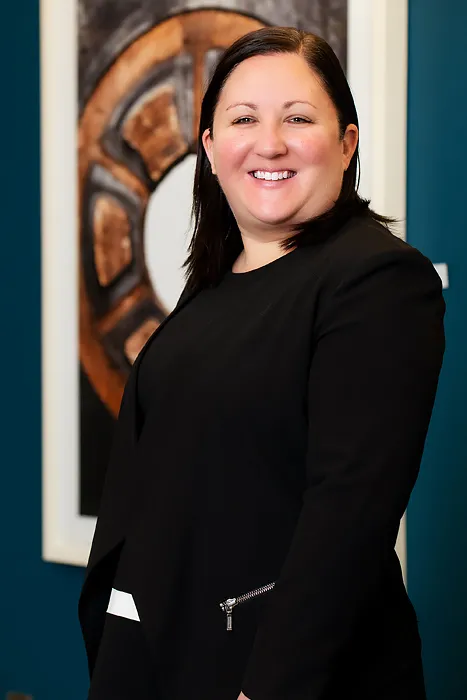
Julie Zamler has never been one to stop at the level she has already reached.
A love of science led to an early career in biopharmaceutical research. Her time in the lab confirmed that she wanted a career with room to keep growing, which ultimately led her to law school. From there, work as a patent legal assistant led to becoming a paralegal, and that foundation ultimately led Julie to become a successful IP attorney at Burris Law.
Alongside that professional journey has been another lifelong pursuit: competitive tennis, which Julie has played since age seven and continues today.
At each stop — in the lab, in law, and even on the tennis court — Julie has followed the same instinct: learn as much as possible, build on what she already knows, adapt, and keep moving forward.
“I was always a math-and-science person,” Julie said. “I knew I wanted science to be part of my career, but I also knew I didn’t want to spend the rest of my life in a lab. Eventually becoming an IP attorney gave me a way to bridge that gap — to bring together the science and technical side with the law.”
From the Lab to Law
Julie earned her undergraduate degree in chemistry from Kalamazoo College (2007) and began her career working for a contract research organization in the biopharmaceutical industry. For more than two years, she worked around preclinical and Phase I human drug trials, where meticulous documentation, regulatory requirements, and accuracy were part of everyday life.
It was valuable experience, but Julie also began thinking about where she wanted her career to go next. “I knew there were only so many pathways I could take if I stayed in the lab,” Julie said. “I could move into management or academia, but I knew in the long run that wasn’t where I wanted to head.”
Law offered another possibility. Julie had lawyers in her family and had seen firsthand what a legal career could look like. More importantly, intellectual property provided a way to keep the scientific background she enjoyed while adding an entirely new layer of strategy, problem-solving, and professional growth.
Julie earned her J.D. and LL.M from Western Michigan University Thomas M. Cooley Law School in 2012 and 2013, respectively. After law school, Julie worked as a patent legal assistant with a national intellectual property firm before joining Burris Law as a paralegal in 2018. Already licensed to practice law in Michigan, she continued building her patent experience before passing the patent bar and becoming a patent attorney in 2020.
Julie specializes in US and foreign trademark prosecution as well as patent preparation and prosecution, handling patent matters in the materials science discipline, such as composite materials and ceramic bonding for both the automotive and semiconductor industries. Julie also has experience prosecuting U.S design patent applications.
“I already had the technical background and my law license, so it was a natural progression,” she said. “I had built that foundation, and then it was about getting to the next level and developing the next set of skills.”
A Scientist’s Eye for the Details
Those early years in biopharmaceutical research still influence the way Julie practices today.
In the lab, virtually everything had to be documented, corrected, and verified. That experience taught Julie to focus not only on accuracy, but also on creating a clear record of how decisions and results were reached.
That mindset translates naturally to patent law. “You have to be able to explain what happened, what transpired, and why the paperwork is what it is,” Julie said. “In the patent world, how an invention came about, who invented it, and how you got to the patent all need to be meticulously preserved and recorded.”
Julie considers herself a visual learner, which makes Burris Law’s distinctive fly-to-client approach particularly valuable to her practice. She has traveled to client facilities, sat down with engineers, toured manufacturing operations, watched components being made and assembled, and physically handled the technologies she was helping protect.
“I can look at figures, pictures, and descriptions on the computer all day long, but actually seeing what something looks like, what it feels like, and how it is made gives you a much more personal understanding of the technology,” Julie said.
Seeing the manufacturing process and talking directly with the people who developed the technology can help an attorney separate what is routine within an industry from what actually makes an invention different, Julie added. “It gives you a better idea strategically of what is truly important. You can really hone in on what they are doing that is new and different and what sets them apart — and then determine what they need to protect for their business.”
Serving Up a Lifelong Passion
Long before Julie began strategizing with patent examiners, she was strategizing across a tennis net. She began playing competitively at age seven, played throughout high school and at the Division III collegiate level, and still competes in leagues and tournaments today.
Tennis is a family affair: her parents still play, as do her sister and brother-in-law, and now her young nephew is learning the game. “I really don’t know life without playing tennis,” Julie said. “It has always been one of those constants for me. There’s always a team, a match, or a tournament going on.”
It turns out the sport has more in common with intellectual property law than might first appear. Julie compares patent and trademark prosecution less to an athletic contest and more to a chess match, but the same strategic mindset applies.
“You have different opponents every match in tennis, and you have different examiners with different philosophies,” Julie said. “You have to understand what is on the other side of the court and figure out the best way to win the match, like you get a patent across the finish line.”
Outside of her IP practice, Julie formerly volunteered with the Oakland Literacy Council in Michigan, tutoring adults learning English as a second language.
“You are teaching people how to navigate everyday life in a new language — how to communicate with employers, through normal daily activities like shopping, school, dining, and handling the countless conversations most native speakers rarely must think about. That was very meaningful work to me.”