
From Taiwan to the U.S. – Li-Hua Weng Brings a Global Perspective to her Patent Practice

Inspired by the IP firm’s distinctive fly-to-client service approach, The Flight Crew highlights the people who shape the firm and deliver the in-person relationships that define Burris Law.
For Burris Law IP attorney Li-Hua Weng, a successful patent strategy often begins with understanding what gets lost in translation.
From Taiwan, Li-Hua can read patent materials in their original Mandarin and Japanese. She works with U.S. and international clients as well as foreign patent associates across Asia and other markets, helping bridge differences in language, patent systems, and legal expectations.
“Sometimes the most important part of a rejection can get lost in translation,” Li-Hua said. “Because I can read Chinese and Japanese Office Actions in the original language, I can understand what the patent office is saying and advise U.S. clients based on the original reasoning, not just a translation. That can be a real advantage when navigating patent matters across different countries.”
That insight also applies to applications from foreign clients seeking patent protection in the United States. A strategy developed under another country’s patent laws may not apply directly to U.S. practice. Li-Hua reviews those instructions, considers the client’s broader goals, and recommends a different path when necessary. For her, the ability to see what others might miss speaks directly to what she finds most rewarding about patent law.
“One of the most rewarding parts of my work is when I can review a client’s proposed strategy, identify a better path forward, and then see the application allowed because of the advice and work I was able to provide. That’s when I know I’ve really added value for the client.”

With more than two decades of experience, Li-Hua joined Burris Law in 2016 after building a patent career that began in Taiwan and continued at major U.S. intellectual property firms. Today, she represents clients across technologies including hand tools, electric heaters, sensors, semiconductor equipment, turbo-jet engine nacelles, and computers. She works closely with inventors to identify the core features of their inventions, establish priorities, and secure meaningful protection while navigating the patent process as efficiently as possible.
From Taiwan to U.S. Patent Law
Li-Hua’s patent career began in Taiwan, where she earned bachelor’s and master’s degrees in mechanical engineering from National Taiwan University. After briefly working as a mechanical engineer, she joined a law firm as a patent engineer and spent about five years in the role before coming to the United States to pursue her law degree.
The idea of coming to the U.S. had appealed to Li-Hua since childhood when she watched people pursue advanced education in the U.S., particularly in technology and engineering. Working as a patent engineer in Taiwan opened her eyes to the growing importance of intellectual property protection. This experience inspired Li-Hua to pursue a legal career, allowing her to perfectly blend her technical background with her passion for patent work.
At first, she did not expect to stay in the U.S. permanently. Her plan was to earn her degree, gain several years of professional experience and eventually return to Taiwan. “I didn’t plan to stay here forever,” she said. “But opportunities kept coming, and I ended up making a life here.”
Li-Hua earned her J.D. from what is now the University of Illinois Chicago School of Law and went on to practice patent law at Harness Dickey & Pierce and Brinks Gilson & Lione. Along the way, she also developed a professional relationship that would eventually lead her to Burris Law.

One of Kelly’s First Calls
By the time Kelly Burris launched Burris Law in 2016, she and Li-Hua had already worked together for more than a decade, including representing the same client at both Harness and Brinks. When Kelly began building her team, Li-Hua was one of her first calls.
“I was very familiar with the work we were going to do,” she said. “It was exciting to be back with Kelly.”
Nearly a decade later, Li-Hua has grown with Burris Law, finding a collaborative environment that fits the way she wants to practice. Attorneys share work, draw on one another’s technical strengths, and step in when a colleague needs assistance. “We work as a team,” Li-Hua said. “When somebody needs help, no one hesitates to step in.”
That collaborative culture complements her practical, efficiency-focused approach to patent prosecution. Over the course of her career, Li-Hua has reviewed thousands of pages of patent applications and prepared hundreds of responses to USPTO Office Actions.
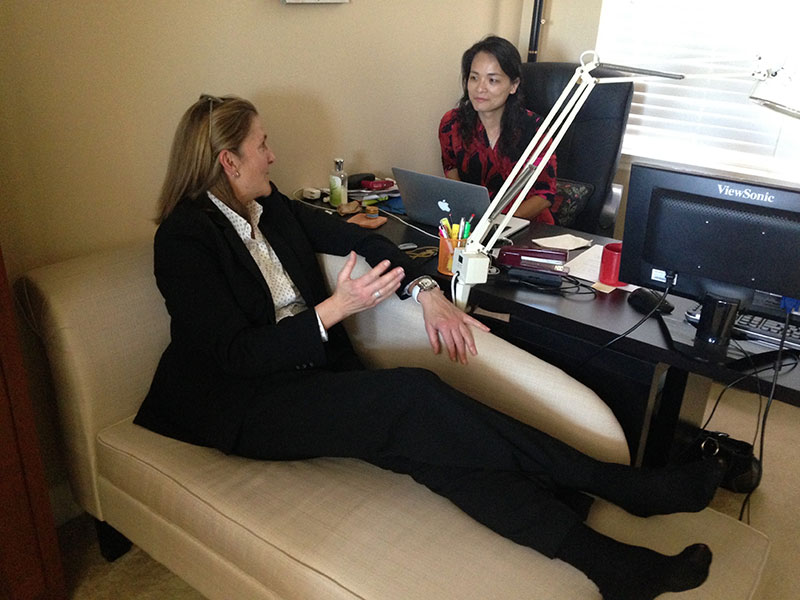
“In serving clients, my goal is to find efficiencies and gain advantages for them,” Li-Hua said. “In most office actions, multiple patents and hundreds of pages must be reviewed to compare features. This can be a time-consuming process, but I am trained to know where to find the critical information and give practical advice to overcome a rejection, even if that means adding new claims or features to advance the application.”
For all the strategy involved in patent practice, one of the things Li-Hua enjoys most is seeing how an invention works in the real world – and sometime seeing it come to market.
“Sometimes you write about something, and then a few years later you see it on the market,” she said. “It’s exciting to think, ‘I already knew about this. I worked on this.’”
From Patent Claims to Piano Keys
Li-Hua’s curiosity extends beyond patent law. Outside the office, she enjoys reading and has recently taken up the piano, embracing another opportunity to learn something new.
This time, the motivation is also personal.
“I started taking piano lessons when my son began learning violin,” Li-Hua said. “My hope is that someday I’ll be able to sit at the piano and accompany him while he plays. I really enjoy learning something new, and it would be special to be able to make music together.”